
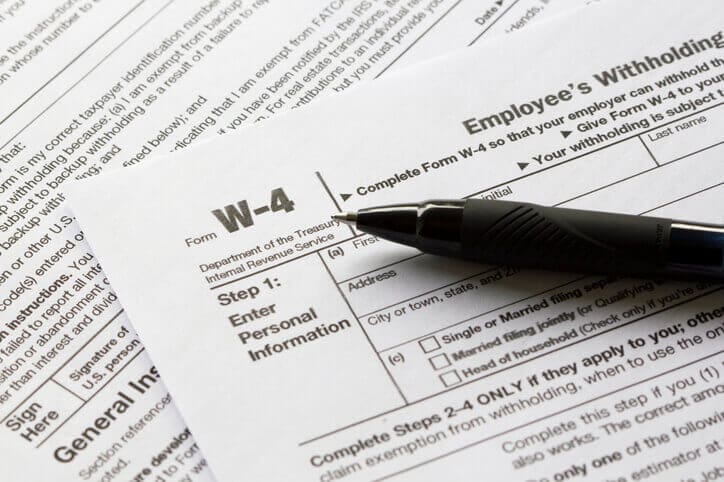
The IRS (Internal Revenue Service) has finalized and released the 2026 version of Form W-4 (Employee’s Withholding Certificate). The updates reflect changes required under H.R. 1—the One Big Beautiful Bill Act (OBBBA; Pub. L. 119-21)—enacted in July 2025.
The new form is now available on the IRS website and will be required for applicable employees beginning January 2026.
Overview of Key Changes
The 2026 Form W-4 is more detailed and data-driven, aligning withholding more closely with updated deductions and credits under OBBBA. These changes are designed to improve accuracy in paycheck withholding and reduce year-end tax surprises.
Why This Matters to Employers
The updated form impacts both payroll administration and employee tax planning:
- Improved withholding accuracy for employees with variable pay, including tips and overtime.
- Cleaner payroll inputs, reducing manual corrections and year-end adjustments.
- Simplified exempt tracking through a new checkbox.
- Better alignment with updated credits, including the increased Child Tax Credit.
Proactive preparation will help minimize disruption during the 2026 transition.
Employee Compliance Requirements
Who Must Submit a 2026 Form W-4?
Most employees with a valid W-4 already on file do not need to complete a new form. Employers will continue using the most recent W-4 on record.
Mandatory Update: Exempt Status Renewal
Employees who claimed exempt from federal income tax withholding in 2025 must submit a new 2026 Form W-4 by February 17, 2026, to maintain exempt status.
If a new form is not received by that date, employers must change the employee’s withholding to:
- Single filing status
- No entries in Steps 2, 3, or 4
IRS Encourages Updates for Employees Who:
- Are newly hired in 2026
- Want to adjust withholding (increase refund or reduce balance due)
- Experience major life changes (marriage, new dependent, second job, significant income changes)
- Need to account for new deductions related to tips or overtime
What Changed in the 2026 Form W-4?
1. Longer Form with Expanded Worksheet
- The form expands to five pages (previously four).
- The Step 4(b) Deductions Worksheet now occupies a full page for clearer calculations.
2. Step 3 (Credits) Is More Structured
- Step 3 is now divided into Line (a) and Line (b).
- The Child Tax Credit increases to $2,200 per qualifying child (up from $2,000).
- The $500 credit for other dependents remains unchanged.
3. Step 4 (Other Adjustments) Is Clearer
- The word “Optional” has been removed from Step 4.
- Step 4(b) now clearly states that if left blank, withholding will default to the standard deduction.
4. Expanded Deduction Entries Under OBBBA
The updated Step 4(b) worksheet includes new dedicated lines for estimating:
- Qualified tip income
- Qualified overtime compensation
- Qualified passenger vehicle loan interest
- Enhanced deduction for individuals age 65+
These additions allow employees to more precisely tailor withholding to their expected deductions.
5. New “Exempt” Checkbox
Employees qualifying as exempt from federal income tax withholding may now simply check a designated box. Previously, they were required to handwrite “Exempt” on the form.
Recommended Employer Action Plan
To prepare for 2026 implementation, employers should:
- Update HRIS and payroll systems to capture the expanded Step 4(b) entries and new exempt checkbox.
- Review onboarding materials and employee communications (FAQs, portals, handbooks) to reflect changes.
- Validate withholding logic once 2026 federal tax tables are released.
- Communicate early with employees most likely impacted—particularly those earning tips or overtime, claiming vehicle loan interest, or age 65+.
Preparing for a Smooth Transition
While the 2026 Form W-4 does not require universal employee action, it introduces meaningful changes that affect payroll configuration and employee education. Early planning and clear communication will help ensure compliance and reduce administrative strain during the transition year.